You write «Reply to the report, one hour, tops» on your list, and three hours later you are still on it.
Almost everyone underestimates their own tasks, so it says nothing about you being slow. There is a simple way to plan better.
The short answer
List every step of the task, estimate each step in Pomodoros, add them up and add one block for surprises. At the end of the day, count how many blocks it really took and use that number next time.
The planning fallacy
Psychologists call it the planning fallacy: people tend to underestimate how long their own tasks will take, even when they have done similar ones before.
The thesis study
In a 1994 study, Buehler, Griffin and Ross asked senior university students when they would finish their honors thesis. On average they predicted 33.9 days. They took 55.5. Only 29.7% finished by the time they had predicted, and even their «worst case» guesses, 48.6 days on average, were too optimistic.
The predictions still followed the real times closely, so the estimates were useful. They were just consistently short.
Why listing steps helps
When we imagine a task we picture the main part and skip the small steps: finding the file, preparing, double-checking, sending.
Kruger and Evans tested this in 2004, in five experiments with tasks such as holiday shopping, getting ready for a date, formatting a document and preparing food. People who listed the subtasks gave longer estimates, and in two of the experiments the estimates were less biased. The effect was bigger for more complex tasks.
How to estimate in Pomodoros
- Write the task as a list of every step, including small ones like gathering the files, reading the brief and sending the final version.
- Estimate each step in Pomodoros: half a block, one block, two blocks. 25 minutes is easier to picture than «an hour and a half».
- Add them up.
- Add one block for surprises. There will be one.
- Do the work in real blocks. A 25/5 session works well.
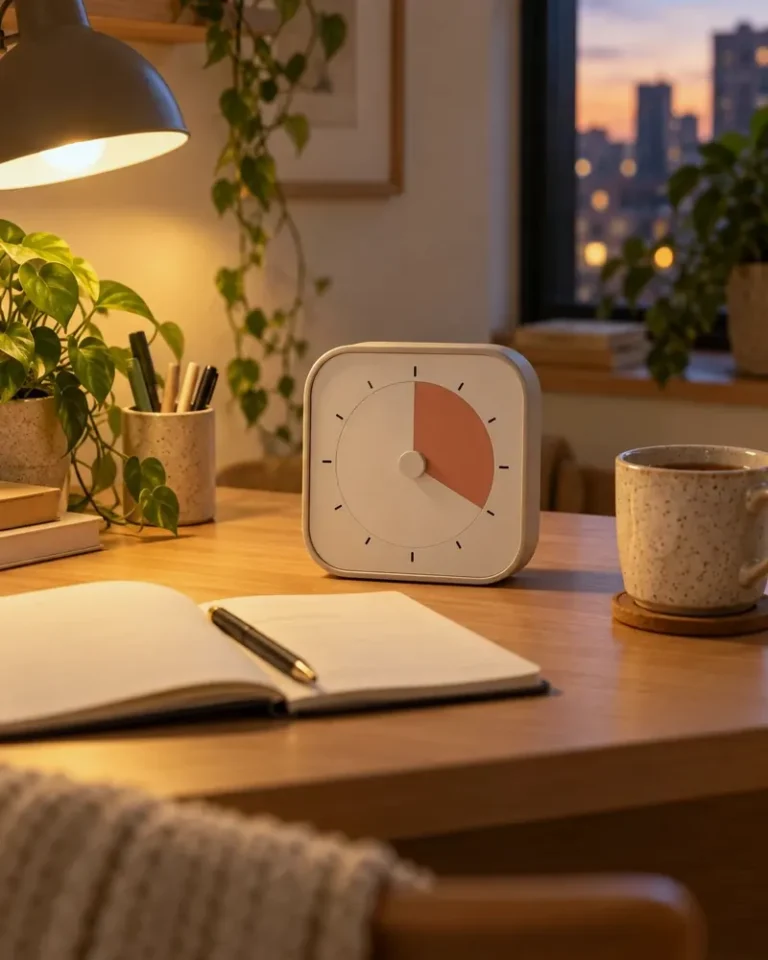
A visual timer on the desk shows how much of a block is left at a glance, and there is one in the picks for seeing time.
Learning from your own numbers
At the end of the day, count how many blocks each task really took and write it next to your estimate. After a couple of weeks you will see your own pattern, for example that emails take twice what you expect while reading takes about what you expect. No general rule can give you those numbers, and running over is useful information for the next list.
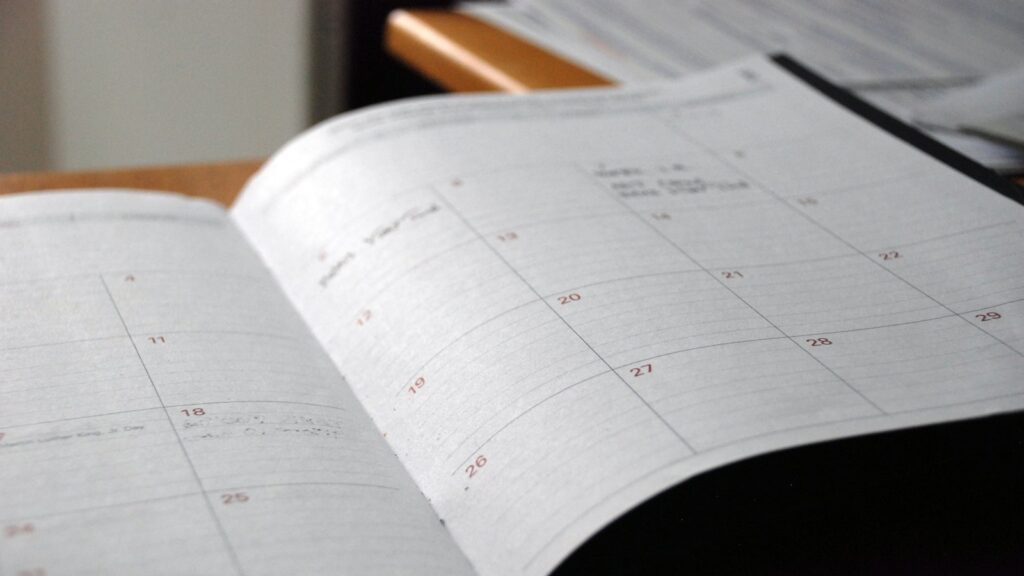
A planner with time blocks works for this, and so does a plain notebook.
When this doesn’t help much
For short, simple tasks like answering a message or filing a document, a gut estimate is usually fine. The list pays off with bigger tasks that have many parts.
Questions people ask
Why do I always underestimate how long things take?
When we imagine a task we picture the main part and miss the small steps. It is very common and has nothing to do with being lazy or slow.
What is the planning fallacy?
The tendency to underestimate how long our own tasks will take, even when we have done something similar before.
How many Pomodoros should a task take?
List the steps, estimate each one in blocks, add a block for surprises, then compare with how many blocks it really took and adjust.
How do I plan my day realistically?
Plan fewer tasks than you think you can handle and count them in blocks. If starting is the hard part, read why starting feels heavy.