The break is the part of the Pomodoro Technique that most people skip or spend in a way that doesn’t rest them. Reaching for the phone «to check something» at the bell often turns five minutes into twelve, and you come back tired and read the same line twice.
Why people skip it
It feels like losing time just when you are moving, or people take it by opening a feed and call that rest. The break is there so that you still have energy for the third and fourth blocks.
What short breaks do
A 2022 meta-analysis by Albulescu and colleagues pooled 22 studies with 2,335 participants on micro-breaks of ten minutes or less. The clearest result was that people felt more vigor and less fatigue afterwards. The same research linked longer breaks with better performance, which is why the classic Pomodoro adds a longer break after three or four blocks.
Why your phone doesn’t count
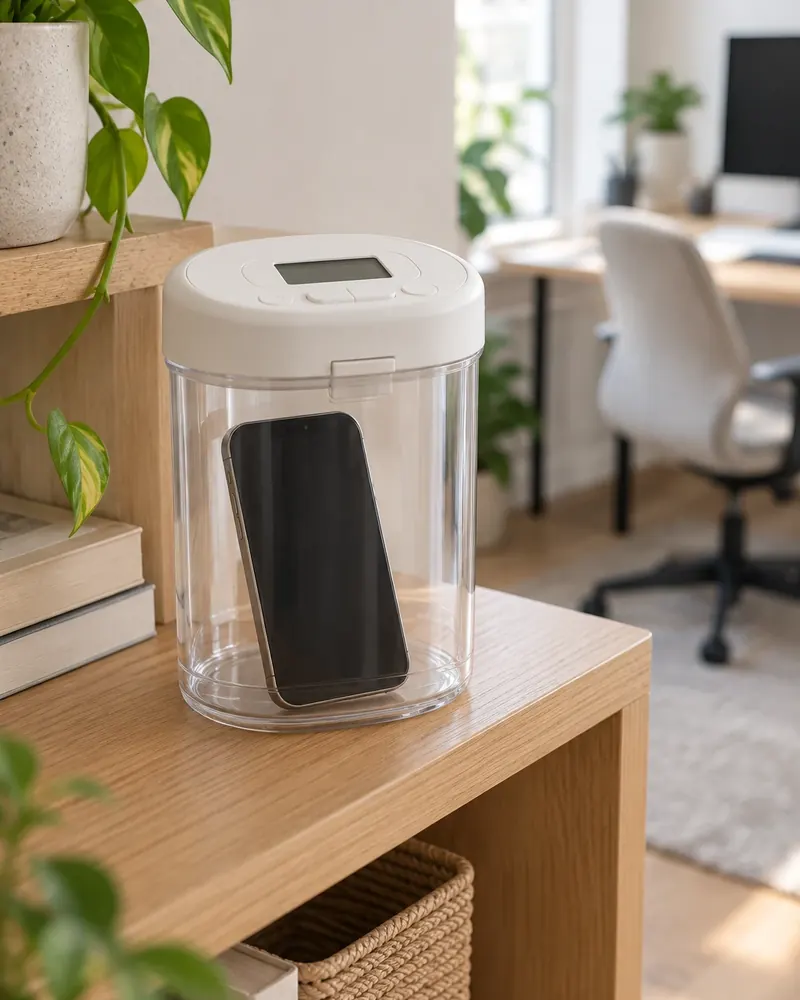
A feed brings new information, new faces and new decisions, it is hard to stop at exactly five minutes, and you come back with your head somewhere else. If your phone keeps winning, put it out of reach for the session. A timed lock box is the firm version.
A five-minute break menu
- Refill your water. A large bottle filled before you start saves trips, though the walk to the tap works as a break too.
- Stand up and stretch your neck, shoulders and back.
- Look at something far away, out of a window if you can, or open it for a minute of fresh air.
- Write one line about where you stopped. It takes ten seconds and the next block starts faster, as in the stop-mid-sentence trick.
Longer breaks
After three or four blocks, take 15 to 30 minutes. Eat something, walk and get away from the desk. If your rhythm keeps cutting you off at the wrong moment, the block may be the problem, and how to choose your Pomodoro rhythm covers that.
Breaks for different kinds of work
After reading or studying, move your body and rest your eyes, and skip anything with text. After writing, walk and let the next sentence come to you. After routine tasks, change the scene with another room, a glass of water or a minute outside.
Every Luneia session has the breaks built in, with a soft bell at both ends, so you don’t need to watch the clock. A 50/10 session is a good one to try this with.
Questions people ask
How long should a study break be?
About 5 to 10 minutes between blocks, and 15 to 30 minutes after three or four blocks, is the classic structure.
Is it bad to use my phone during study breaks?
It isn’t forbidden, but a feed rarely lets you rest and it is hard to stop on time. You could try phone-free breaks for a week and compare how the third block feels.
What should I do in a 15-minute break?
Eat, walk, step outside or tidy something physical, anything that gets you away from the screen.